Outdoor living & pool landscaping: uses, shade and water research
Compiled by Patriot Pools & SpasReviewed October 5, 2026Survey findings, studies & official guidance
A backyard plan needs places to sit, routes that work and planting that fits its conditions. The pool is one part of that everyday experience.
This guide connects homeowner survey findings with official landscape guidance. It separates the uses people reported from the soil, shade and maintenance questions that need a property-specific answer.
Backyard landscaping for the way people actually live
Outdoor space can support a quiet morning as well as a group around the pool. Decide which uses deserve room before filling the plan with features.
The Houzz survey found several common uses among people undertaking outdoor renovations. Its respondents could include more than one kind of area. The useful planning question is which activities matter to your household and where they fit relative to the pool and house.
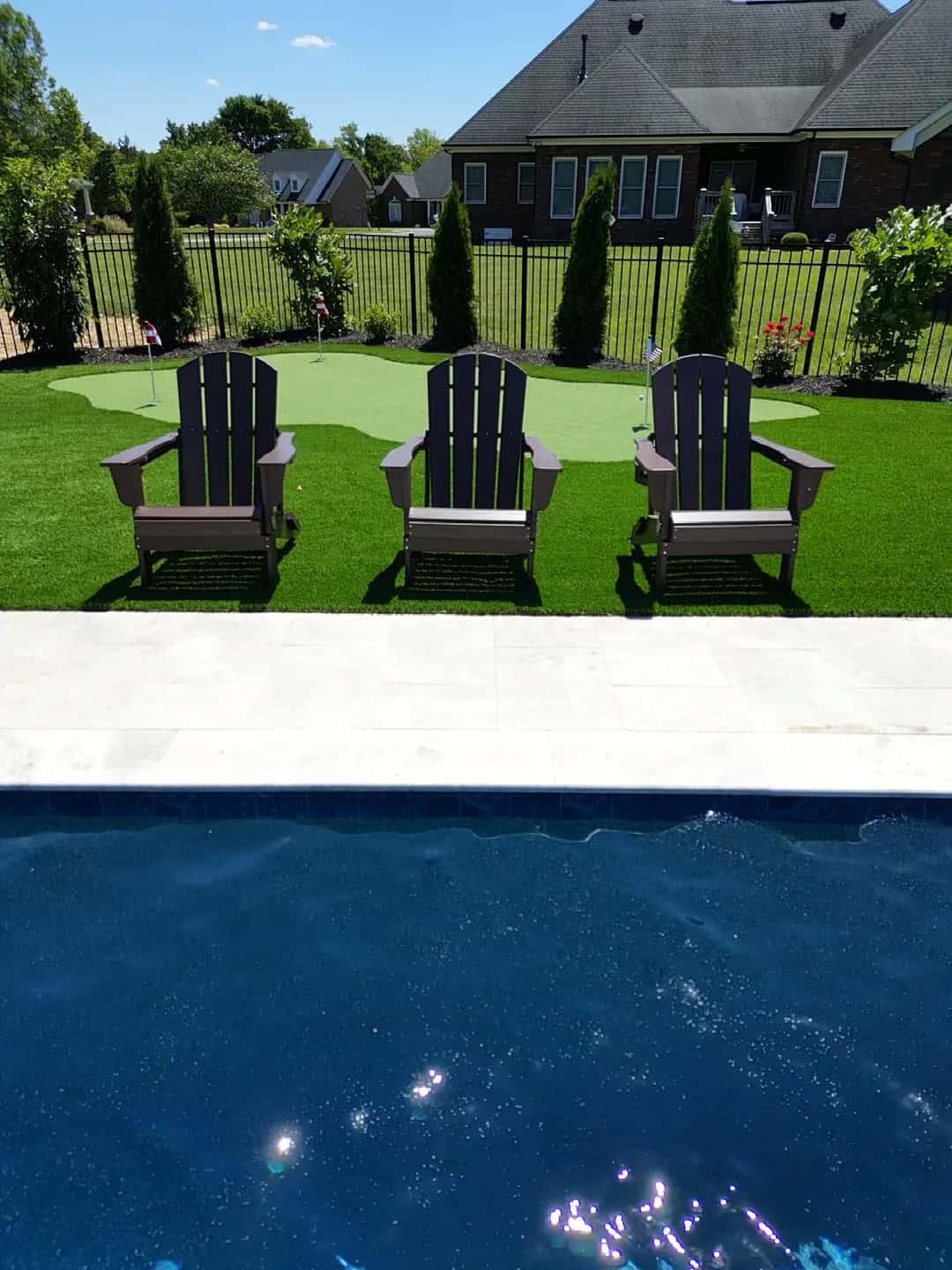
In Patriot’s project photographs, the pool, paved terrace, seating and putting green have distinct places. Use the images to discuss those relationships. They illustrate one completed layout; they do not establish what every property can accommodate.
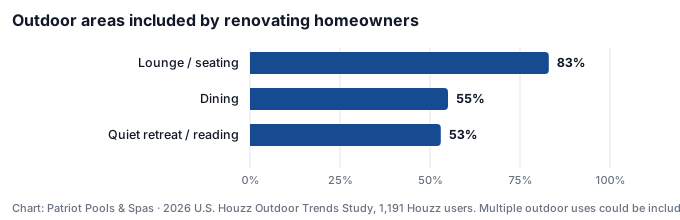
Outdoor areas included by renovating homeowners2026 U.S. Houzz Outdoor Trends Study, 1,191 Houzz users. Multiple outdoor uses could be included; not a Charlotte sample.
In the 2026 Houzz outdoor-renovation survey, 83% of renovating homeowners included lounge or seating areas.
Seating was the most common outdoor living space.
Scope: 1,191 U.S. Houzz users recently renovating, planning or undertaking outdoor renovation; survey April 25-May 6, 2026 Houzz respondents, not all U.S. homeowners or a local forecast.
In the 2026 Houzz outdoor-renovation survey, 55% of renovating homeowners included dining areas.
Dining was a common use alongside lounging.
Scope: 1,191 U.S. Houzz users recently renovating, planning or undertaking outdoor renovation; survey April 25-May 6, 2026 Respondents could plan multiple outdoor uses.
In the 2026 Houzz outdoor-renovation survey, 53% of renovating homeowners included quiet retreats or reading areas.
Outdoor plans included quieter everyday activities.
Scope: 1,191 U.S. Houzz users recently renovating, planning or undertaking outdoor renovation; survey April 25-May 6, 2026 Houzz survey respondents; no Charlotte subset reported.
Professional planning, privacy and useful sightlines
Privacy works best when you identify the view that matters. A screen can be designed around that need instead of filling every boundary with the same planting.
NC State identifies plant and built-screen options. Consider the available space, mature growth and upkeep when comparing them. A boundary screen and access protection for the water are different design questions; address each explicitly.
Houzz’s professional-use finding describes the choices survey respondents made. It does not prove that hiring a professional causes a particular outcome. A practical design conversation should show how the proposal addresses your intended uses and property constraints.
In the 2026 Houzz outdoor-renovation survey, 71% of renovating homeowners hired a professional.
Professional participation increased compared with the previous survey.
Scope: 1,191 U.S. Houzz users recently renovating, planning or undertaking outdoor renovation; survey April 25-May 6, 2026 Survey association, not proof a professional causes better outcomes.
Custom landscaping around pools: site fit before the plant list
Drainage, sunlight and space for mature growth give the planting list its limits. A familiar species or a native label does not answer every site question.
NC State’s planting-site screening method can flag poor drainage. It does not establish an engineered infiltration rate or solve runoff around a pool. If water movement is affecting the hardscape or house, bring that into the property-specific design discussion.
Native range is useful context, but growing conditions still decide whether a plant fits a bed. Choose the location and conditions before using a plant label as the deciding factor.
A future canopy is not immediate shade. Plan where people will sit now and how the planting changes the yard over time.
DOE’s tree guidance describes air-temperature comparisons and the time a slow-growing tree may need to shade a roof. Neither is a pool-deck temperature rating. Use those distinctions when comparing an immediate shade arrangement with a long-term planting plan.
The view from the house, the hours you use the pool and the area you want shaded belong in the brief. A planting that solves one sightline may not shade the seating at the time you use it.
Publication date not supplied · Accessed 2026-10-05
05 / backyard landscaping
Landscape irrigation after the backyard changes
New beds, turf and paving change where water belongs. The irrigation system should follow the finished layout rather than continue its old pattern.
EPA’s comparisons and expert estimate explain why efficient scheduling and system checks matter. They do not predict a saving at an individual home. Look for where water lands, whether the pattern matches the planting and whether the conditions have changed.
Separate plants with different watering needs into suitable hydrozones. If natural grass is part of the design, the turf reference includes historical Charlotte-area irrigation modeling with its limits. Artificial turf has a different maintenance discussion; replacing lawn irrigation does not establish zero water use.
EPA says experts estimate as much as 50 percent of water used outdoors is wasted through overwatering caused by inefficient irrigation methods and systems.
Review how irrigation applies water to the landscape.
Scope: Official guidance; not a population survey Expert estimate cited by EPA; not a measured loss for every home.
Mulch and construction access around existing trees
An established tree is part of the site brief. Construction access and later planting care need different plans.
NC State describes a protective mulch layer for construction traffic and a different depth for ordinary woody-plant beds. Do not interchange those recommendations. Keep the intended use of the material attached to the instruction.
Ask how access and staging will protect desirable plants during the work, then request an upkeep plan for the completed landscape. That plan should account for the actual plants and materials beside the pool.
Bring the use pattern, not just an inspiration image
Describe where you want to sit, how you move from the house and which views you want screened. Identify the plants and features you hope to keep. The design center can discuss a coordinated pool, spa, turf and landscape around that brief.
Connect planting with water movement
A planting list should reflect drainage and growing conditions. Ask how the beds, lawn, paving and irrigation will work together. If there is a recurring wet area, include it in the design conversation before choosing materials.
Ask what the finished yard will require
Discuss mulch, mature growth, irrigation checks and construction protection as part of the scope. Immediate shade and future tree shade need different expectations. Request care instructions matched to the selected plants and installed systems.
What should a backyard landscaping plan include besides a pool?+
In the 2026 Houzz outdoor survey, lounging, dining and quiet retreats were common planned uses. Start by deciding which of those activities matters to your household.
NC State Extension describes a planting-site test in which water remaining after 24 hours indicates poor drainage. That screening does not replace an engineered drainage design.
How much mulch should I put around shrubs and trees?+
For the described woody-plant area, NC State Extension recommends 2 to 3 inches of organic mulch and at least 6 inches of clearance from the trunk or crown.
Will planting trees immediately shade my backyard?+
DOE notes that a slow-growing tree may take up to 10 years to shade a roof. The time and location of shade depend on the tree and site; plan immediate and mature shade separately.
Are native plants always the best fit around a pool?+
Native range is one factor. NC State Extension emphasizes ecoregion and growing conditions, so check sunlight, drainage and the space available for the mature plant.
Should I replace all the grass around a pool with turf?+
That is a layout and product decision. Compare the intended uses, shade, heat, drainage and upkeep using the turf reference. The landscape evidence does not establish one best surface for every backyard.
Can custom landscaping fix a wet backyard?+
Planting-site screening can identify poor drainage, but it is not an engineered drainage design. Ask for the water movement and site conditions to be assessed before choosing planting or paving as the solution.
A current quote needs the actual site and scope: planting, finished surfaces, preparation, drainage and ongoing care. This collection does not verify a current Patriot price or universal local landscaping average. Use the evidence to refine the brief, then compare complete proposals.
READ THE LIMITS AS WELL AS THE RESULTS
How this guide was compiled
This is a source compilation, not original Patriot survey research. We opened primary publications, retained the relevant population and conditions, and separated measurements from official instructions. Manufacturer examples identify their model and do not imply Patriot stocks that product. An independent reviewer checked the source findings before release. We prefer a smaller useful evidence set to unsupported figures or repeated statistics.
The research group considered 42 candidate findings; 16 sourced entries are included on this page. Sources were checked on October 5, 2026. The collection includes numeric findings and qualitative official guidance; those labels are shown separately. Our refresh schedule is quarterly, with earlier checks for revised guidance.
Source publication dates stay separate from the date this guide was reviewed. Undated pages are marked as such. Historical studies and national project benchmarks remain dated; they are not current Patriot prices or local forecasts.
What the available evidence does not settle
Houzz respondents were undertaking or planning outdoor renovation. Their choices are not a survey of every U.S. or Charlotte household.
Official planting guidance does not determine the right species, spacing or drainage design for your property.
The shade figures compare air conditions and tree growth; they do not provide pool-deck surface temperatures.
Why some candidate findings were left out
A universal Charlotte inground-pool price: No current first-party Patriot quote or representative primary local dataset verified; use scoped dated national benchmark only.
Universal pool construction timeline: No primary dataset suitable for this business and approval jurisdiction; do not invent a weeks-to-completion statistic.
Charlotte ownership percentage or pools per household: No current primary ownership dataset verified.
2025 CPSC drowning report figures: Superseded for this collection by the June2026 release; do not mix reporting windows.
DOE heat-pump consumer guidance at cmei/buildings/consumer-heat-pump-swimming-pool-heaters: URL could not be retrieved; do not reuse remembered COP data as newly verified.
EPA 2022 assertion that all pumps sold since2021 must be variable speed: Overbroad summary of equipment rules; exclude from consumer design claims.
CDC spa chemical thresholds as extra pool-building statistics: Reserve chemistry detail for the water-care hub; no count padding.
Charlotte climate-normal rainfall using USC00201476: Search returned Charlotte,Michigan station; inappropriate location. Actual Charlotte NC April norms fetched but not used as irrigation prescription.
NC State landscape design25% household energy reduction: Headline estimate without underlying study visible; avoid using as measured poolside cooling.
DOE2021 airconditioner10% shading efficiency: Tangential HVAC claim; this collection should focus backyard use and accurate shaded-air comparison.
NAR2023 outdoor kitchen price: Patriot outdoor-kitchen service not independently established; no implication that the company sells this exact project.
EPA2026 mulch3-4in versusNCState2-3in: Retain source- and application-specific NCState woody-plant recommendation rather than universal conflicting mulch depth.
When using a finding, keep its source, date and qualifications. Cite the original publication for the underlying research and this guide when crediting the compilation.
Patriot Pools & Spas. Outdoor living & pool landscaping: uses, shade and water research. Updated October 5, 2026. A compilation of cited primary sources. https://www.patriotpoolsandspas.com/research/outdoor-living-landscaping-statistics