Artificial turf vs grass: heat, water, upkeep & putting-green research
Compiled by Patriot Pools & SpasReviewed October 5, 2026Survey findings, studies & official guidance
A green-looking yard can hide very different decisions about heat, water and upkeep. Compare the actual surface and installed system, not a blanket promise that one choice solves everything.
This guide brings sports-surface measurements, historical Charlotte lawn modeling and manufacturer instructions together. It identifies which evidence can inform a backyard discussion and which findings should not be treated as residential product guarantees.
Artificial turf versus grass: what the research measured
Most published heat experiments tested sports surfaces. Keep the tested system, location and weather with each finding before applying it to a backyard choice.
The newer review synthesizes sports-surface research. That is useful evidence about the kinds of thermal differences researchers observed, but the settings, materials and methods vary. A range across studies is not a prediction for a current residential turf product.
Ask which turf system is proposed for your yard and which tested performance information applies to it. A statement that turf is either always cool or always a fixed amount hotter than grass leaves out the conditions that make the comparison useful.
A 2024 systematic review identified 23 studies comparing thermal conditions on synthetic sports surfaces with natural grass or other synthetic systems.
The authors used narrative synthesis rather than a pooled estimate.
Scope: Systematic review of sports-surface studies searched through April 6, 2023. Heterogeneous methods; no meta-analysis. Not a residential turf product test.
The 2024 review summarized higher synthetic-grass surface temperatures versus natural grass in a range of 9.4-33.7°C across included sports-surface studies.
This range is not a residential-lawn forecast.
Scope: Systematic review of sports-surface studies searched through April 6, 2023. Heterogeneous methods; no meta-analysis. Not a residential turf product test.
The 2024 review summarized higher air temperatures over synthetic versus natural sports surfaces in a range of 0.5-1.2°C.
The authors distinguish air temperature from surface temperature.
Scope: Systematic review of sports-surface studies searched through April 6, 2023. Heterogeneous methods; no meta-analysis. Not a residential turf product test.
Surface temperature is different from air temperature
A weather-app reading cannot tell you how a particular surface will feel. Matched measurements help explain the distinction; they do not rank every current product.
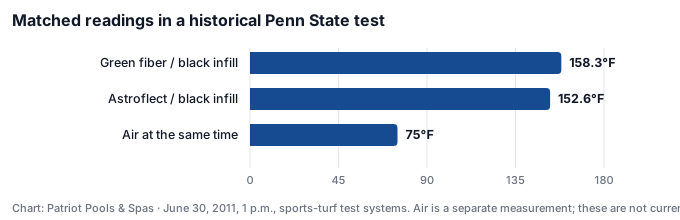
Penn State’s historical experiment recorded different surface systems at the same time. Those matched observations help distinguish the surface from the surrounding air. The chart preserves the tested materials and date rather than relabeling an old sports system as Patriot’s residential turf.
Around a pool, discuss exposure and intended use along with the material. A putting green and an area where people sit can have different priorities. Request the selected supplier’s temperature guidance and account for the conditions at the actual site.
Matched readings in a historical Penn State testJune 30, 2011, 1 p.m., sports-turf test systems. Air is a separate measurement; these are not current residential product ratings.
Penn State measured 158.3°F on its green-fiber, black-infill sports-turf test system at 1 p.m. on June 30, 2011.
The report identifies the tested fiber and infill combination.
Scope: Historical sports-surface test at University Park, Pennsylvania, June 30, 2011. Different materials and conditions from a residential installation.
Penn State recorded air temperature of 75°F at the same 1 p.m. time point on June 30, 2011.
Air temperature and surface temperature describe different measurements.
Scope: Historical sports-surface test at University Park, Pennsylvania, June 30, 2011. Different materials and conditions from a residential installation.
Penn State measured 152.6°F on its Astroflect-fiber, black-infill test system at 1 p.m. on June 30, 2011.
This comparison uses the same outdoor test time and location.
Scope: Historical sports-surface test at University Park, Pennsylvania, June 30, 2011. Different materials and conditions from a residential installation.
North Carolina supports both cool-season and warm-season lawns. Historical local modeling provides context, while actual irrigation depends on rainfall, soil and the lawn being maintained.
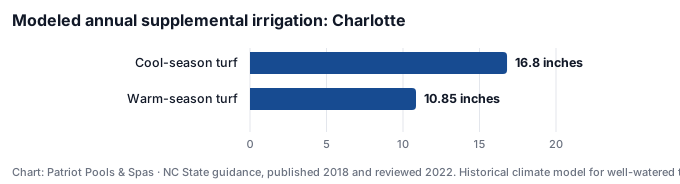
NC State’s modeled Charlotte guidance is one of the locally relevant datasets in this collection. It uses historical weather and a soil-water balance for well-watered grass, separating cool-season and warm-season turf. It is supplemental irrigation, not total rainfall or a measurement of one household’s use.
The annual and June figures are different time periods. They are displayed separately below. Actual rainfall, soil and the desired lawn condition still need to govern irrigation; do not turn the model into a fixed timer setting for the current week.
Modeled annual supplemental irrigation: CharlotteNC State guidance, published 2018 and reviewed 2022. Historical climate model for well-watered turf; not current weather or a household forecast.
NC State's historical Charlotte-area model lists 16.80 inches of annual supplemental irrigation for well-watered cool-season turf.
The model incorporates rainfall and representative soil conditions.
Scope: Table 7 Charlotte-area modeled requirements for well-watered turf, using long-term climate averages and representative soils. Reviewed November 2022; not a current weather forecast or watering instruction.
NC State's historical Charlotte-area model lists 10.85 inches of annual supplemental irrigation for well-watered warm-season turf.
The model is a planning guide requiring site adjustment.
Scope: Table 7 Charlotte-area modeled requirements for well-watered turf, using long-term climate averages and representative soils. Reviewed November 2022; not a current weather forecast or watering instruction.
NC State's historical Charlotte-area model lists 3.13 inches of June supplemental irrigation for well-watered cool-season turf.
Seasonal requirements differ between grass types.
Scope: Table 7 Charlotte-area modeled requirements for well-watered turf, using long-term climate averages and representative soils. Reviewed November 2022; not a current weather forecast or watering instruction.
NC State's historical Charlotte-area model lists 2.05 inches of June supplemental irrigation for well-watered warm-season turf.
The publication advises adjusting guidance for actual conditions.
Scope: Table 7 Charlotte-area modeled requirements for well-watered turf, using long-term climate averages and representative soils. Reviewed November 2022; not a current weather forecast or watering instruction.
Cooling and eliminating lawn irrigation are different questions. A wet surface can cool temporarily, so cleaning and comfort-related water use belong in the maintenance discussion.
Penn State’s trial measured cooling after irrigation and subsequent warming. Its lesson is that a temporary change in a tested surface does not establish a lasting cool-turf guarantee. The natural-grass maximum is a separate observation from that trial, not a matched reading at the moment the synthetic treatment crossed its threshold.
Replacing natural grass can change the irrigation task. Cleaning, pet-related care and attempts to cool a surface are separate reasons water might still be used. Ask for the chosen system’s maintenance instructions before treating artificial turf as a zero-water installation.
The product backing, underlying base and outlet should be discussed together. Ask for the actual installed system instructions, especially around seams, furniture, pets and reflected heat.
SYNLawn’s manual calls for upkeep and identifies preventable damage. Those are instructions for its systems, not evidence that every residential turf product uses the same infill or requires the same routine. Follow the instructions for the installed product.
Discuss the backing, base and destination for water together. A published backing drainage rate would not establish the performance of the entire yard. Include nearby reflective windows, seams, furniture, planting debris and intended activities in the supplier conversation.
Putting-green performance starts with the intended use
A putting surface is different from general landscape turf. Discuss putting, chipping, contours and the feel you want, then request the selected product specifications rather than assuming every green plays alike.
Choose the experience you want before comparing a product rating: casual putting, practice, contours or a place to gather. A manufacturer’s Stimp rating describes the named product; the installed shape and maintenance still belong in the discussion.
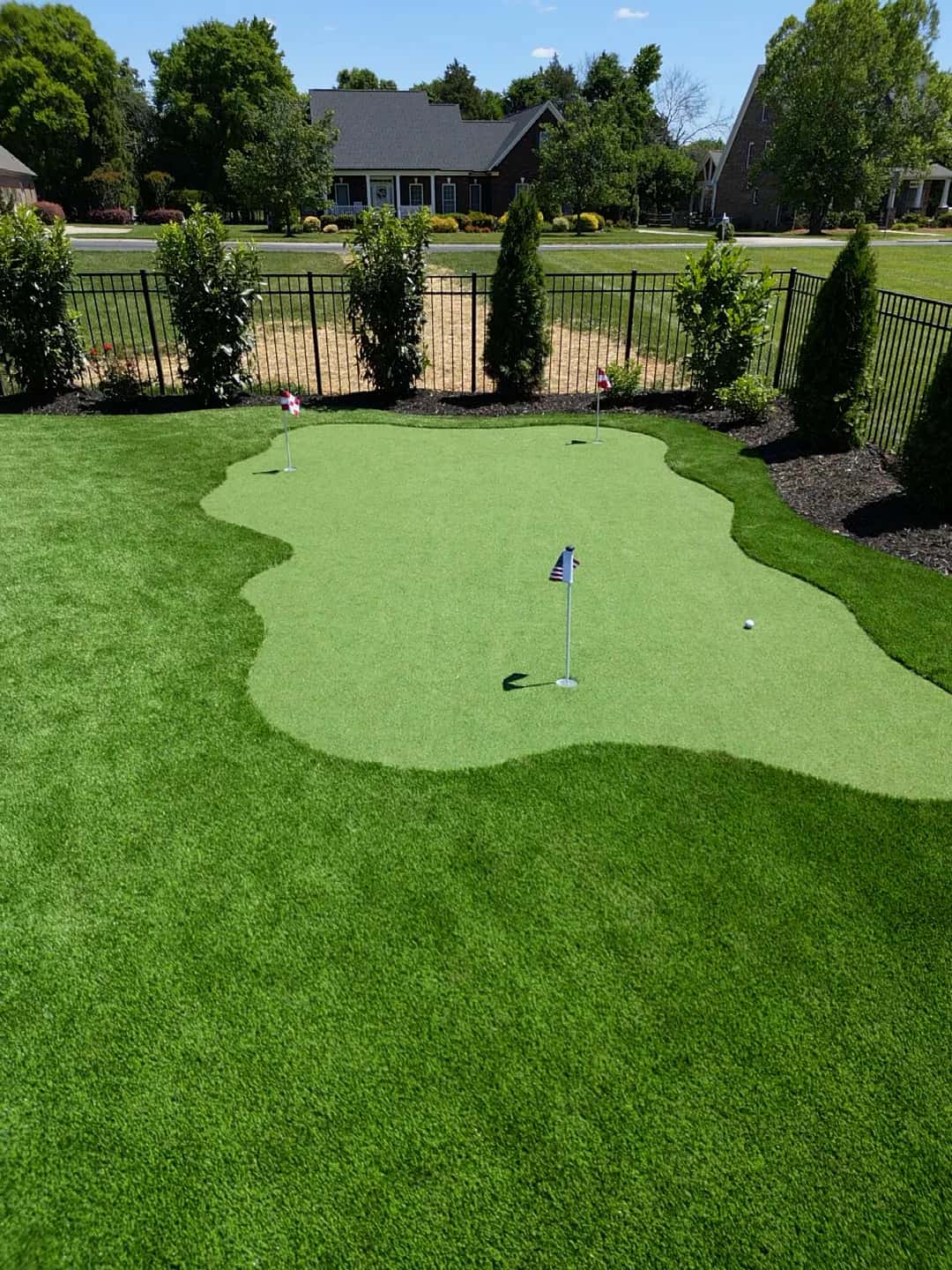
Patriot’s photographs show a distinct putting surface, fringe and nearby seating. They can help frame a design conversation about the space around the green. They do not confirm the supplier or ball-roll performance of that photographed project.
As of October 2026, SYNLawn lists a Stimp ball-roll rating of 10-12.5 for its Precision Putt TRI product.
The rating belongs to the named putting surface.
Scope: Product-specific manufacturer rating accessed October 5, 2026. Not independent field testing or a promise about every putting green; Patriot supplier not verified.
Publication date not supplied · Accessed 2026-10-05
Use the evidence in your next decision
Separate the poolside lawn from the putting surface
Describe the activities each area needs to support. Discuss the intended playing feel for the green and the everyday use of the surrounding turf. Bring questions about contours, edges and access around the water into the same design conversation.
Ask for the actual product and system instructions
Request information for the selected surface, base and drainage approach. Read the warranty and upkeep requirements together. Product-specific examples in this reference are evidence of published specifications, not confirmation of Patriot’s supplier.
Plan for comfort and upkeep
Review exposure, reflected heat and the areas used for sitting or play. Ask how debris will be removed and which brushes or cleaning methods suit the selected product. A surface can reduce one task while introducing a different care routine.
The 2024 sports-surface review reported higher synthetic surface temperatures. Its results concern varied sports systems, not a predicted temperature for every residential lawn.
The Penn State irrigation trial shows temporary cooling from watering; SYNLawn also describes cleaning and upkeep. Replacing lawn irrigation does not establish zero water use.
NC State publishes modeled Charlotte-area guidance for cool-season and warm-season turf. It calls for adjustment to actual conditions, so the table is not today's watering schedule.
SYNLawn warns about reflected heat and melting under variable conditions. Review nearby reflective surfaces with the chosen supplier before installation.
This collection did not verify a representative service-life dataset for residential turf in Patriot’s service area. A warranty term is not measured lifespan. Ask for the selected product’s warranty, exclusions and maintenance requirements rather than applying one number to every installation.
What does artificial turf installation cost?+
No current Patriot price or representative local installation-cost dataset was verified. Compare the actual scope: the chosen surface, area, base preparation, drainage, edges and putting-green design where relevant. Ask for a property-specific proposal.
Will artificial turf solve my backyard drainage problem?+
A turf surface and a complete drainage design answer different questions. Ask how the backing, base and water outlet work together at the property. This guide does not establish a guaranteed drainage rate for Patriot’s installations.
READ THE LIMITS AS WELL AS THE RESULTS
How this guide was compiled
This is a source compilation, not original Patriot survey research. We opened primary publications, retained the relevant population and conditions, and separated measurements from official instructions. Manufacturer examples identify their model and do not imply Patriot stocks that product. An independent reviewer checked the source findings before release. We prefer a smaller useful evidence set to unsupported figures or repeated statistics.
The research group considered 38 candidate findings; 16 sourced entries are included on this page. Sources were checked on October 5, 2026. The collection includes numeric findings and qualitative official guidance; those labels are shown separately. Our refresh schedule is quarterly, with earlier checks for revised guidance.
Source publication dates stay separate from the date this guide was reviewed. Undated pages are marked as such. Historical studies and national project benchmarks remain dated; they are not current Patriot prices or local forecasts.
What the available evidence does not settle
Sports-surface experiments are not temperature ratings for Patriot’s current residential turf products.
Historical Charlotte irrigation modeling is not today’s watering requirement and is not a whole-property water saving calculation.
No universal turf lifespan, local installed cost, zero-water claim or health-safety guarantee was verified.
The narrow evidence set relies on university research and specific manufacturer instructions. That source concentration is disclosed rather than padded with roundup statistics.
Why some candidate findings were left out
Universal residential turf lifespan or installed cost: No representative primary data confirmed; warranty duration is not measured service life, and Patriot prices are unverified.
A universal artificial-turf surface temperature: Studies have different systems, weather, measurement times and uses.
Cool turf guarantees and safety claims: Manufacturer promotional language does not establish universal heat performance or health safety.
Sports thermal-review numbers presented as residential tests: Scope differs; retained only with sports-study and review qualifiers.
CMHA PAV-GSP-013-21-US PDF surface tolerances: Primary URL failed to fetch. Search snippets were insufficient for verification.
Unilock paver-sealing pros and cons page: Primary URL failed to fetch. Replaced with fetched manufacturer FAQ.
EPA 152°F and 10-16°F values as primary pool-deck measurements: EPA summarized Phoenix street research. Cited the fetched original ASU report instead and kept street/coating qualifiers.
A permeable-paver regulatory credit for every patio: Eligibility requires applicable design and review; not a universal installed-product benefit.
When using a finding, keep its source, date and qualifications. Cite the original publication for the underlying research and this guide when crediting the compilation.
Patriot Pools & Spas. Artificial turf vs grass: heat, water, upkeep & putting-green research. Updated October 5, 2026. A compilation of cited primary sources. https://www.patriotpoolsandspas.com/research/artificial-turf-research